Architecture
How it's built
How the briefing is put together, in three pictures: the whole system, one morning's run, and how each published number is produced. Select a diagram to open it full size.
The system
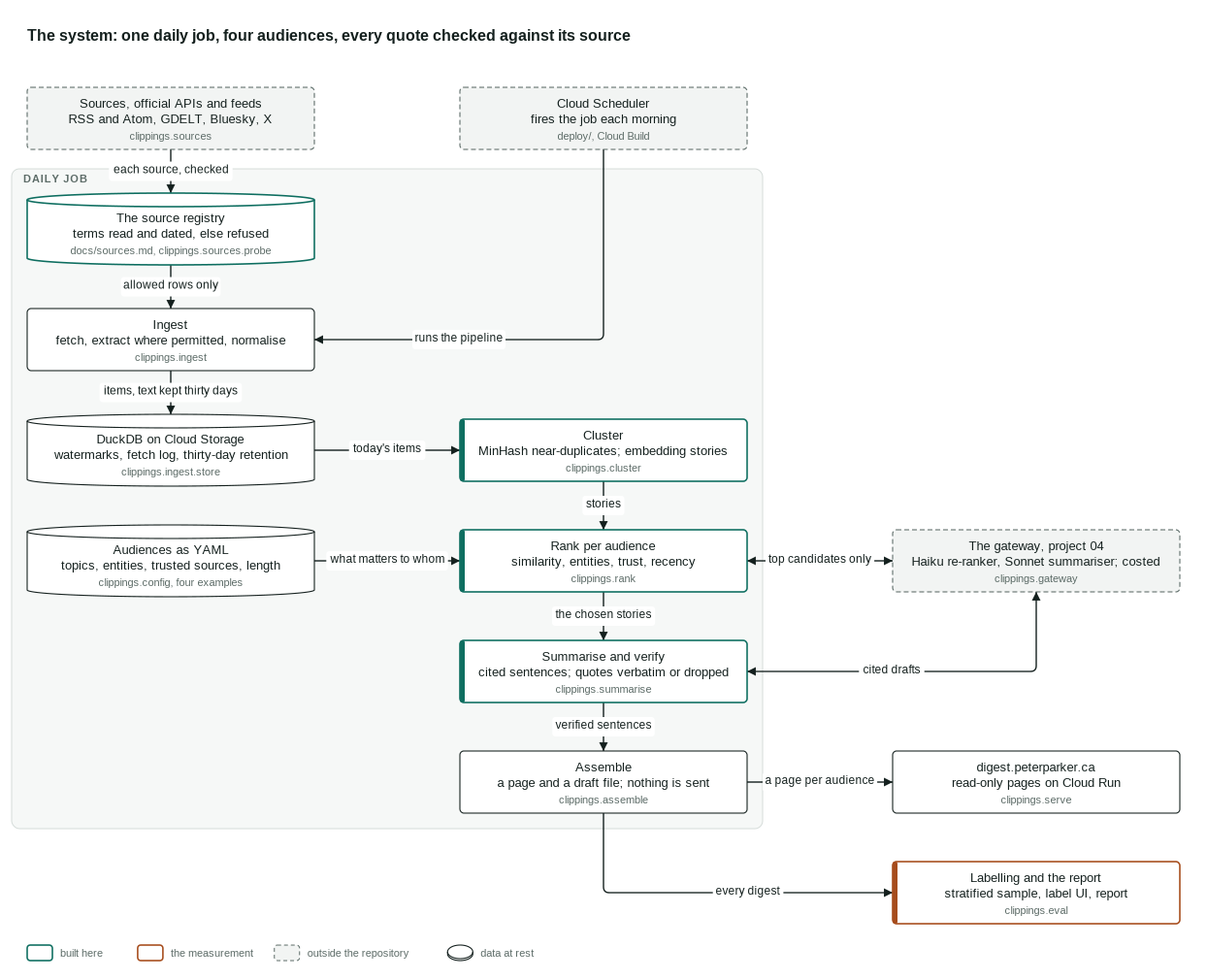
Every morning a scheduled job runs on Google Cloud.
It starts with a gate. The list of sources is not just documentation: a source is fetched only when its entry says its terms of use were read, and when. The job then fetches from official feeds and APIs, keeps the article text only where the terms allow, and stores everything in a small database that remembers what it has already seen and deletes items after thirty days.
Next it sorts the news. Copies of the same article are collapsed, and different reports of the same event are grouped into one story. Each audience is a short configuration file listing its topics, organisations, people, places and trusted sources, and stories are ranked against it by relevance, the sources involved and how recent they are. Only the top candidates go to an AI model for a second opinion, through the portfolio's gateway, which records and costs every call.
Then a model writes the summary, and a checker holds it to account. Every sentence must cite its sources, and every quote must appear word for word in a source it cites. A sentence that fails gets one chance to be repaired, and is dropped if it still fails.
Finally, a page per audience is published, along with a draft email file. Nothing is ever sent. The pages are served read-only at digest.peterparker.ca, and a separate labelling tool and report measure the digests against days labelled by hand.
Where it lives: deploy/, docs/sources.md, clippings.sources, clippings.ingest, clippings.cluster, clippings.rank, clippings.config, clippings.gateway, clippings.summarise, clippings.assemble, clippings.serve and clippings.eval.
One morning's run
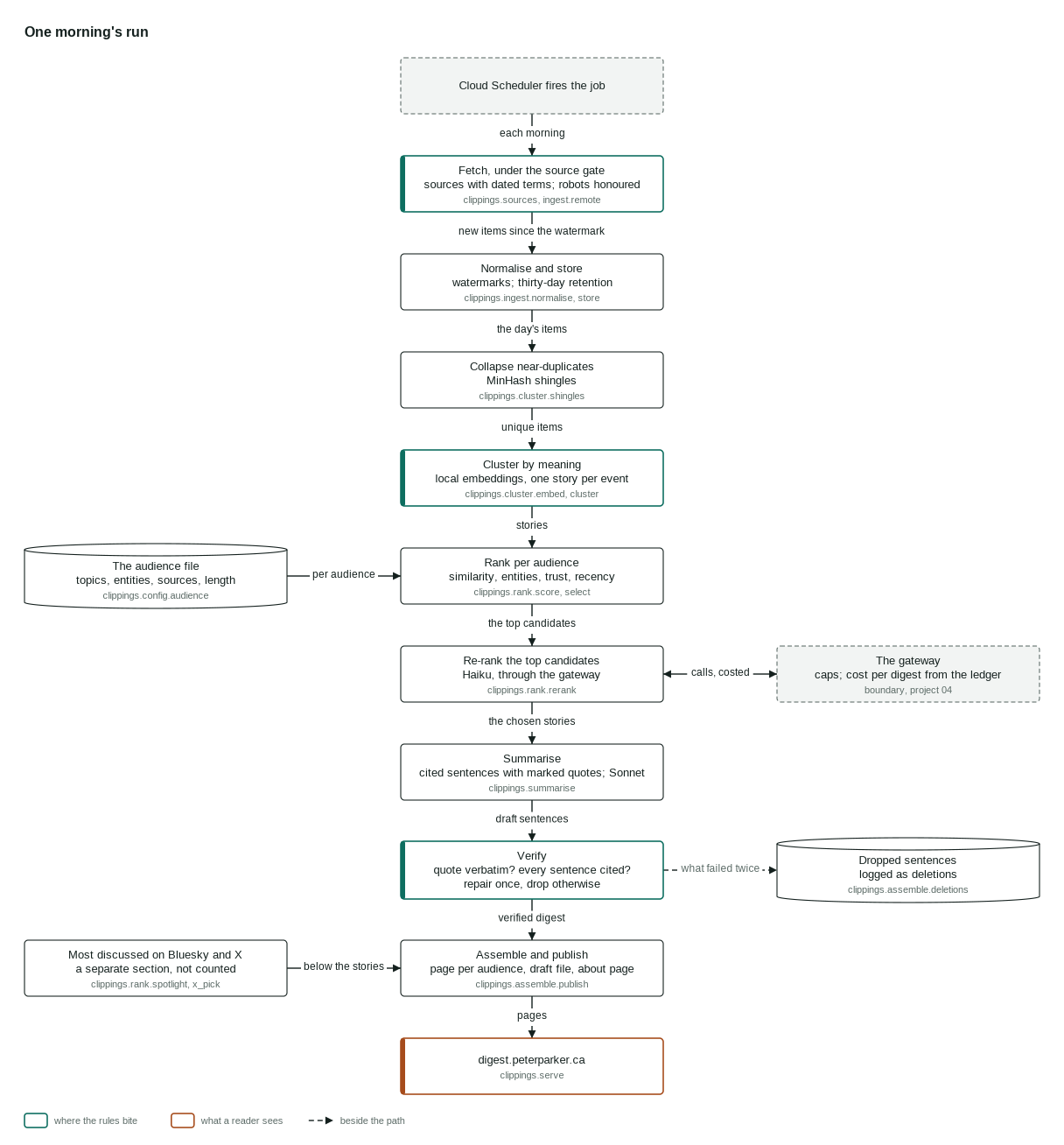
This is one morning, from the scheduler to the published page.
The job fetches only what is new since the last run, from sources whose terms have been read, and respects each site's rules for automated readers. It stores and tidies what it fetched, collapses near-duplicate articles by comparing overlapping runs of words, and groups the rest into stories by meaning, using a small embedding model that runs on the job itself.
For each audience it ranks the stories, and only the top candidates are re-ranked by a small, fast Claude model. A larger Claude model then writes cited sentences with marked quotes. Each sentence is checked: any quote must appear word for word in its source, and every sentence must cite one. A failure gets one repair, then it is dropped and the drop is recorded.
The day's most-discussed posts on Bluesky and X go in a separate section, which is not counted when the digest's accuracy is measured. The page for each audience, the draft email and the about page are then published.
Where it lives: clippings.sources, clippings.ingest.remote, clippings.cluster.shingles, clippings.cluster.embed, clippings.rank, clippings.summarise, clippings.assemble.deletions, clippings.rank.spotlight and clippings.assemble.publish.
How the published numbers are produced
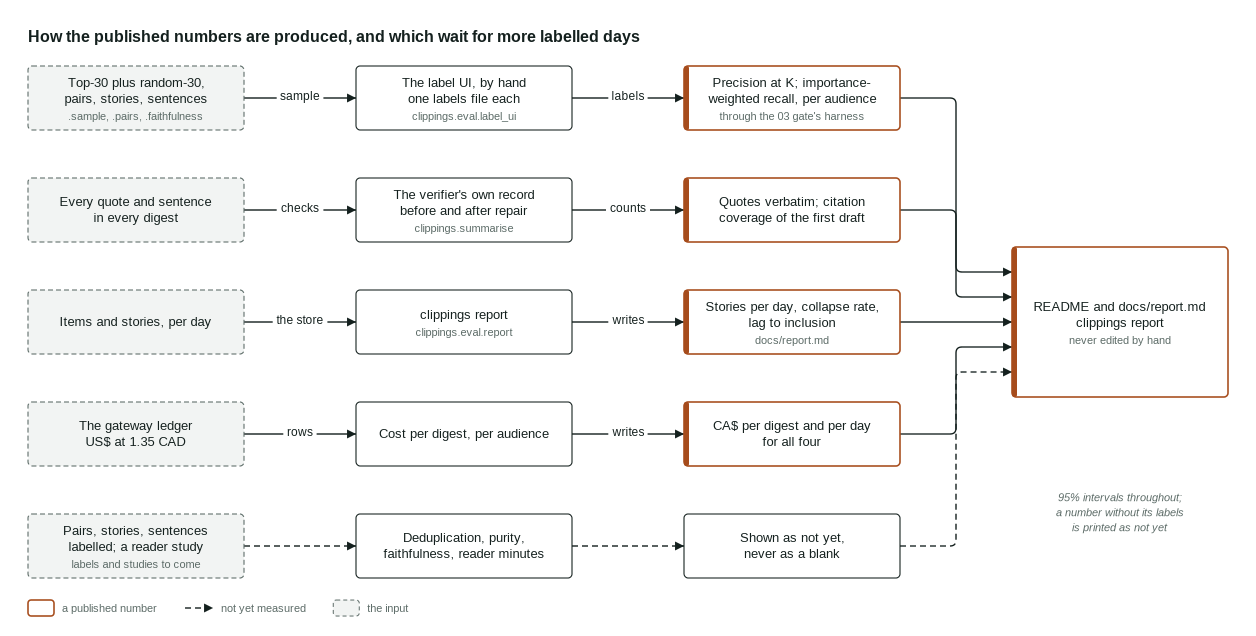
Every number in the README has a stated source, and some are still waiting for theirs.
How many of the stories shown were worth showing, and how many important stories were caught, come from days labelled by hand. For each audience and day, a sampler picks the top 30 stories plus 30 at random, a person labels them in a small labelling tool, and they are scored with the release gate's method, with intervals. The intervals redraw whole days, because stories from one morning share a news cycle and are not separate pieces of evidence. Twenty-eight audience-days are labelled so far, and the numbers fill in as more are done.
How often quotes were exact before and after repair, and how many first-draft sentences carried a citation, come from the checker's own record. Stories per day, how often duplicates were collapsed and how long a story takes to appear come from the database. The cost per digest and per day comes from the gateway's ledger, converted to Canadian dollars. What the ledger does not see, the Google Cloud bill and X's pay-per-use charges, is read by hand from each vendor's billing page into docs/bills.yaml, with the period and the day it was read, and added to it.
How well duplicates are detected comes from pairs of articles labelled "same story" or not, on a second page of the same tool. Each day it asks about pairs the clustering joined, pairs it kept apart that share many words, and a couple of others as a check. A third page shows every story made of several articles and asks which articles do not belong, which gives the share of articles that sit in the right story.
How faithful the summaries are comes from a fourth page. It draws four sentences from each day's digest over a week per audience, about a hundred and ten in all, and shows each one beside what the summariser read of the sources it cites, with its quotes and numbers marked. A person judges whether the sources say everything the sentence says. The checker has already proved the quotes and numbers; this is the check for a paraphrase that goes further than its source.
How much time a reader saves comes from a timed study: three readers, each briefed on five mornings, some from the digest and some from the news items it was made from, the two swapped between readers. Uptime comes from the store: a day is up when the 09:00 UTC run, or its automatic retry, published every audience's digest, and down when a person had to step in.
Anything still waiting for its labels or its readers is printed as "not yet" rather than left blank. One command writes the README and the report, and neither is edited by hand.
Where it lives: clippings.eval.sample, clippings.eval.pairs, clippings.eval.faithfulness, clippings.eval.label_ui, clippings.eval.reader_study, clippings.eval.uptime, the gateway ledger and clippings report.